FLOWSCOPY: Unravelling unsteady fluid flows in porous media with 3D X-ray micro-velocimetry
Keywords: subsurface storage, groundwater, fluid flow, micro-CT methods
Funding: ERC Starting Grant
PI: Tom Bultreys
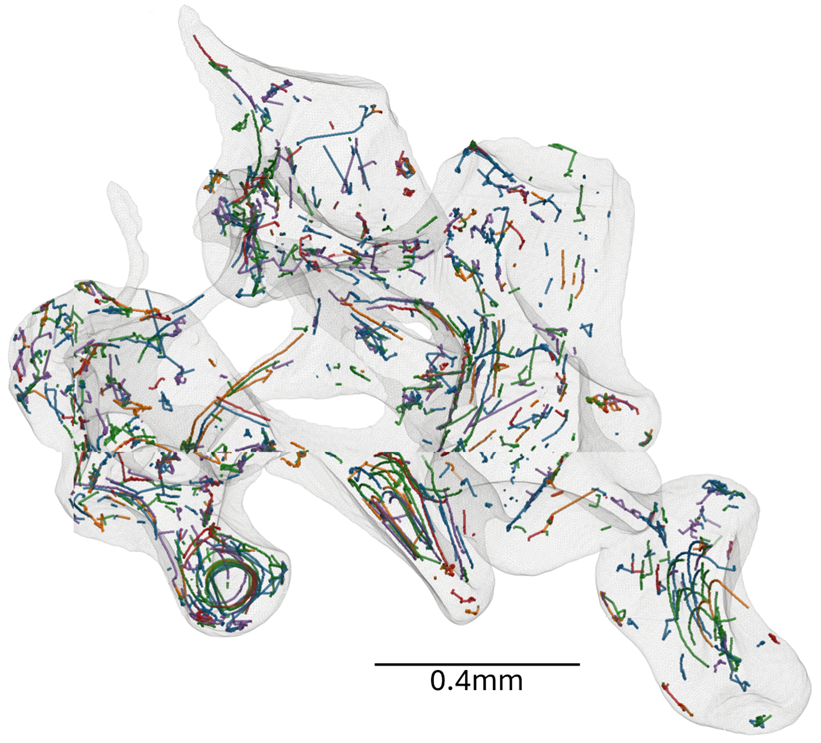
Particle tracks within an oil ganglion trapped within a model rock sample, highlighting recirculating flows due to interfacial drag. The oil/water interface is in light grey while the particle tracks are in colour. The glass grains are fully transparent.
Fluid dynamics in porous materials pose significant challenges due to complex microscopic interactions, which traditional models struggle to capture. Hindered by the optical opacity of materials, understanding these dynamics, crucial in processes like groundwater flow and fuel cell operation, has been limited. EU-funded FLOWSCOPY introduces an innovative 3D X-ray micro-velocimetry technique, advancing understanding of fluid dynamics in porous settings. This method tracks tracer particles for detailed microscale fluid movement observation within opaque materials, marking a leap in imaging speed and detail, from nanometric to centimetric scales. Its primary applications include examining fluid interactions in geological formations and studying viscoelastic fluids for environmental cleanup. FLOWSCOPY promises wide-ranging potential in fields from geology and environmental science to medical imaging and construction.
FIGURE: Particle tracks within an oil ganglion trapped within a model rock sample, highlighting recirculating flows due to interfacial drag. The oil/water interface is in light grey while the particle tracks are in colour. The glass grains are fully transparent.
Underground hydrogen storage
Keywords: subsurface storage, fluid flow, microbiology, chemical reactions
Funding: Fluxys, Belgian Federal Department of Economics
PIs: Tom Bultreys, Nico Boon, Joris Thybaut
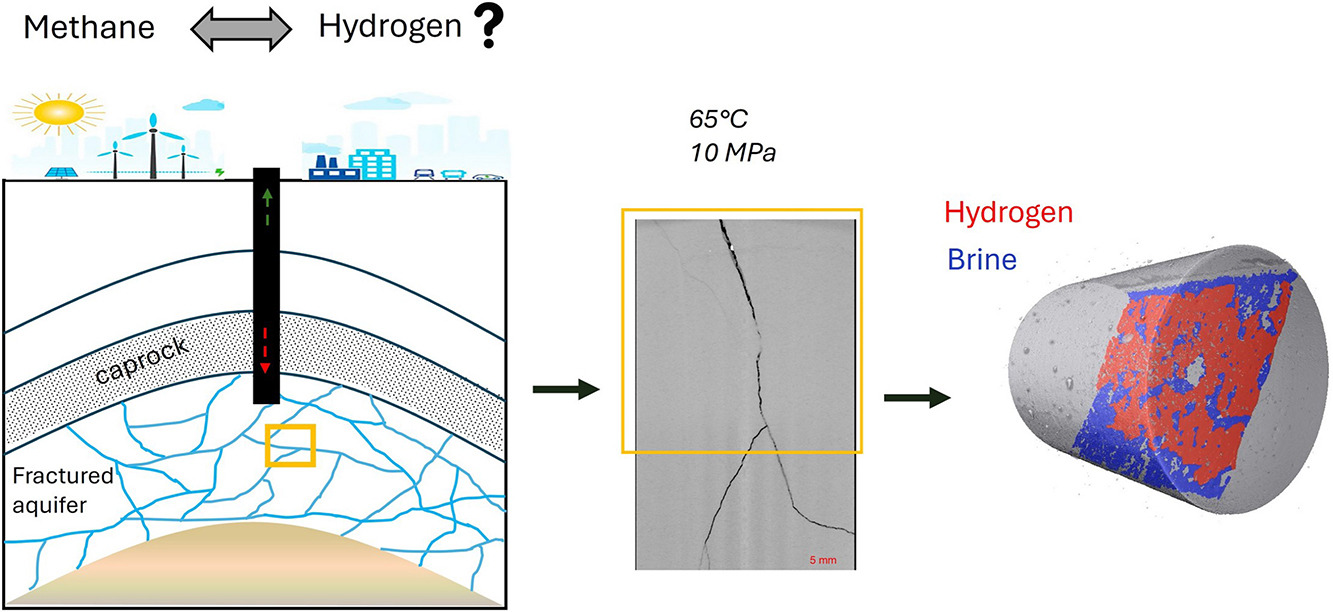
Microscale displacement dynamics of hydrogen and methane in fractured rock: Insights for repurposing natural gas sites for hydrogen storage. See: Manoorkar et al. (2026).
Underground hydrogen storage is an emerging clean energy technology that involves storing hydrogen gas in deep geological formations. By enabling large quantities of energy to be stored over long periods of time, this technology is considered a promising solution for balancing intermittent renewable energy sources such as wind and solar power and for supporting the transition to a low-carbon energy system. PProGRess investigates underground hydrogen storage in porous reservoirs, investigating flow, transport and bio-geo-chemical reactions of hydrogen and the native groundwater in porous rocks. One of our flagship projects is BE-HyStore, a Belgian research project investigating the feasibility of underground hydrogen storage in deep porous rock formations at the Loenhout storage site in Belgium. The project brings together researchers from Ghent University and industrial partner Fluxys to study the geological, geochemical, microbiological, and engineering aspects of hydrogen storage underground, with the broader aim of assessing its safety, efficiency, and potential role in future sustainable energy infrastructure.
FIGURE: Microscale displacement dynamics of hydrogen and methane in fractured rock: Insights for repurposing natural gas sites for hydrogen storage. See: Manoorkar et al. (2026).
ERupT: Can ERT reveal the dynamics of volcanic hydrothermal systems?
Keywords: natural hazards, fluid flow, micro-CT methods
Funding: FWO, MSCA-ITN
PIs: Thomas Hermans, Corentin Caudron, Tom Bultreys, Ellen Van de Vijver
Experimental investigation of bubble flow physics in microstructures
Keywords: fluid flow
Funding: Von Karman Institute
PIs: Delphine Laboureur, Sara Gonzalez Ruiz, Tom Bultreys
Fluid transport and hydromechanical coupling in fractured rocks
Keywords: natural hazards, fluid flow, mechanics
Funding: Australian National University
PIs: Nicolas Francois, Tom Bultreys
Multiphase flow in porous media:investigating characteristic time and length scales from μm to cm using 4D micro-CT
Keywords: subsurface storage, groundwater, fluid flow, micro-CT methods
Funding: FWO
PIs: Tom Bultreys
Multiphase fluid flow through porous sediments and rocks in the subsurface is crucial for various geological applications, such as underground gas storage and groundwater remediation. The actual flow and displacement of fluids take place at the pore scale, that is, within the voids between rock grains. This means that understanding multiphase flow at the pore scale is essential to grasp it at the application scale. In this work, a combination of pore-network modeling, laboratory-based micro-CT, and synchrotron experiments is used to investigate these questions. These fundamental insights are valuable for improving models aimed at the efficient management and prediction of large-scale subsurface processes, such as CO₂ storage, renewable energy storage, and groundwater contamination remediation.
Monitoring PFAS contamination and its remediation in the subsurface from the pore to the field scale
Keywords: groundwater, fluid flow
Funding: FWO
PIs: Tom Bultreys, Flore Rembert, Thomas Hermans
Pore-scale imaging of solute and colloid transport
Keywords: groundwater, fluid flow, micro-CT methods
Funding: Ghent University
PIs: Veerle Cnudde, Tom Bultreys
Energy storage in the geological subsurface: impact of salt precipitation in porous media
Keywords: crystallization, subsurface storage, fluid flow
Funding: FWO
PIs: Veerle Cnudde, Tom Bultreys, Hannelore Derluyn
Solving barriers to time-resolved 3D x-ray imaging with a new data acquisition and processing paradigm
Keywords: micro-CT methods
Funding: FWO, FAPESP
PIs: Matthieu Boone, Jan Aelterman, Tom Bultreys, Nathaly Lopes Archilha, Eduardo Micheles
Tiny yet impactful? Unraveling the interactions between microplastics and sedimentary rocks
Keywords: building materials, fluid flow, chemical reactions, crystallization
Funding: FWO
PIs: Hanne De Lathauwer, Veerle Cnudde
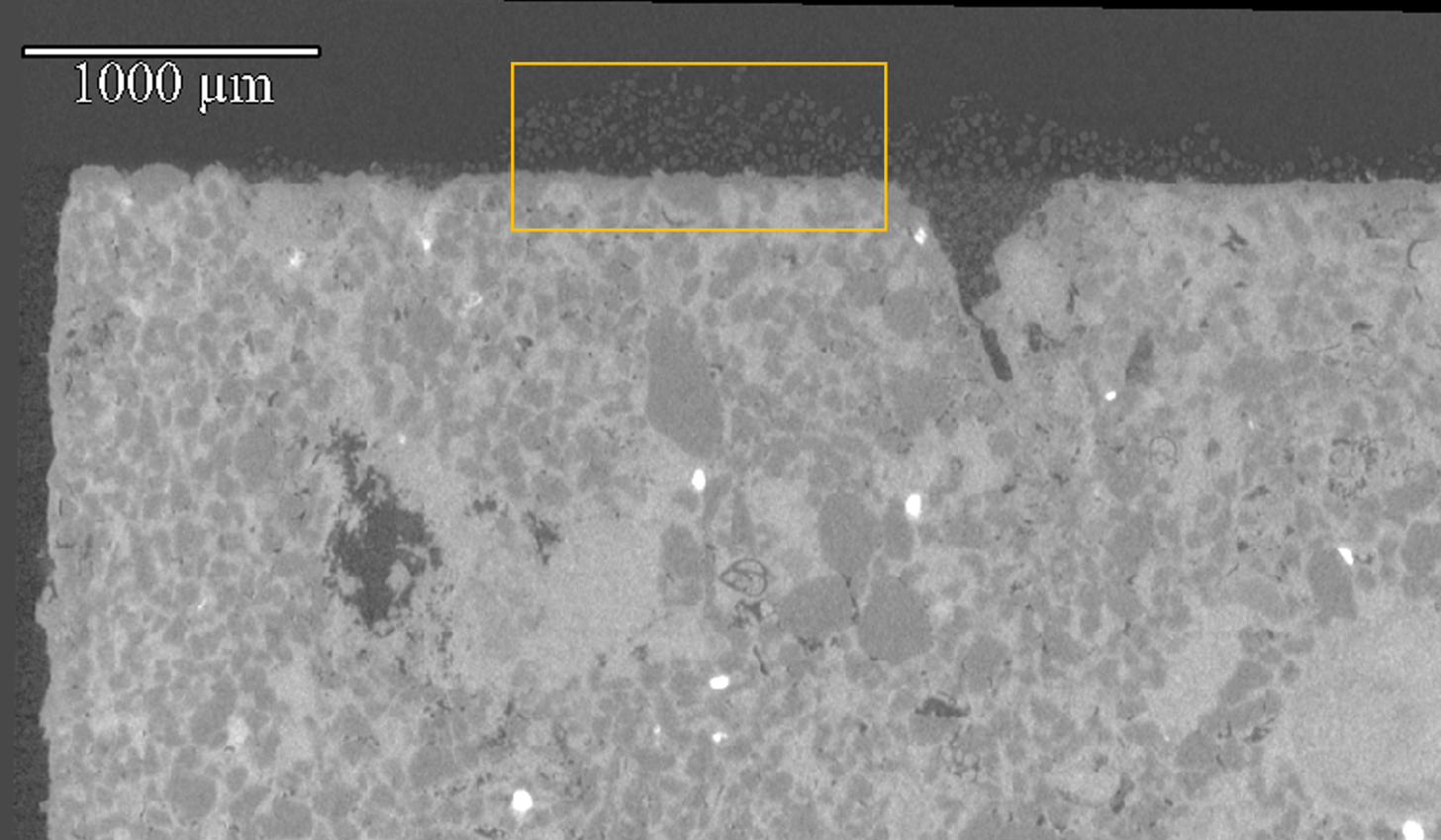
Visualisation of polyethylene microplastic fragments (square) on the surface of Lede stone using µCT.
In recent years, microplastic pollution has become a worrying global problem, attracting increasing attention from the scientific community and policymakers. Numerous scientific studies have investigated sources, behaviour, occurrence and transport mechanisms of microplastics in different environments. Nevertheless, many questions remain unanswered. In particular, the interactions between microplastics and sedimentary rocks are as yet unknown. This research project will combine laboratory work, advanced 2D and 3D imaging- and experimental techniques to provide a fundamental understanding of the dynamics between microplastics and sedimentary rocks on the macro-, meso- and micro-scale.
FIGURE: Visualisation of polyethylene microplastic fragments (square) on the surface of Lede stone using µCT.
3D textural and mineralogical investigation of critical element mineralization in LCT pegmatites
Keywords: raw materials, micro-CT methods
Funding: BOF-UGent
PIs: Florian Buyse, Veerle Cnudde
Enhanced X(cross)-disciplinary Community-driven Imaging Technologies for Earth and Environmental material research
Keywords: natural hazards, building materials, raw materials, subsurface storage, groundwater, fluid flow, chemical reactions, crystallization, microbiology, mechanics, micro-CT methods
Funding: Horizon Europe
PI: Veerle Cnudde
BugControl: Towards protecting and improving building stones through microbial-manipulation of pore structure
Keywords: building materials, fluid flow, microbiology, crystallization, chemical reactions, mechanics
Funding: NWO
PI: Veerle Cnudde
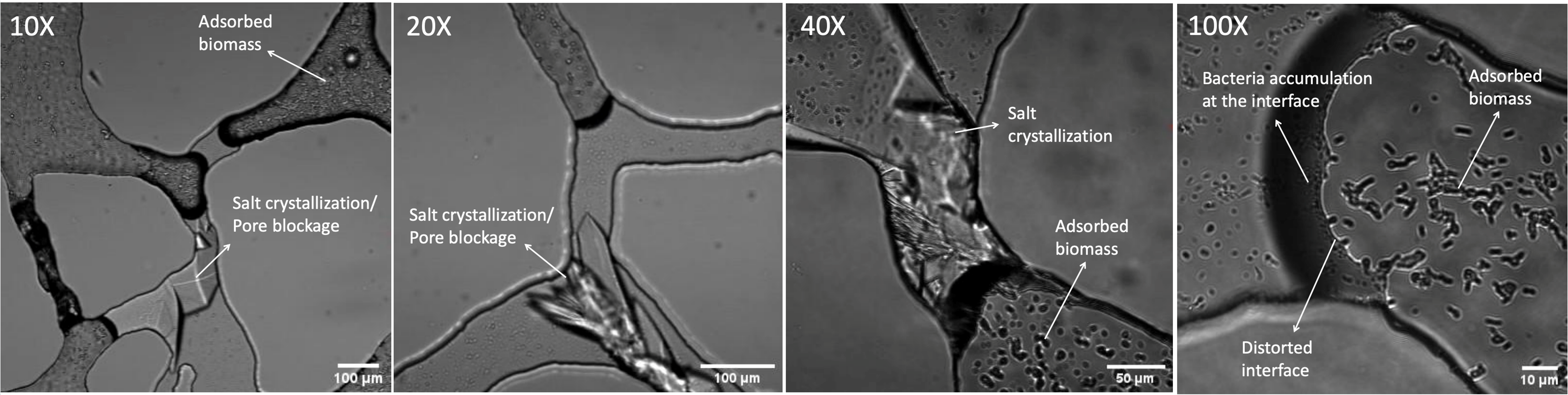
Evidence of biomass aggragation, bacterial adsoprtion on walls, and salt crystallization during evaporation of microbial brine (confocal laser scanning microscopy).
The project aims to use microbial colonization to protect and conserve building stones. The research seeks to develop bio-conservation strategies to control weathering, benefiting cultural heritage preservation, environmental geology, and CO2 sequestration. Advanced 4D imaging will help understand fluid-rock interactions and predict microbial impacts on rock properties.
FIGURE: Evidence of biomass aggragation, bacterial adsoprtion on walls, and salt crystallization during evaporation of microbial brine (confocal laser scanning microscopy).
3D multi-scale structural characterization and long-term performance of lime-based mortars related to efflorescence
Keywords: building materials, raw materials, chemical reactions, crystallization
Funding: Horizon Europe (Marie Sklodowska-Curie project)
PI: Veerle Cnudde
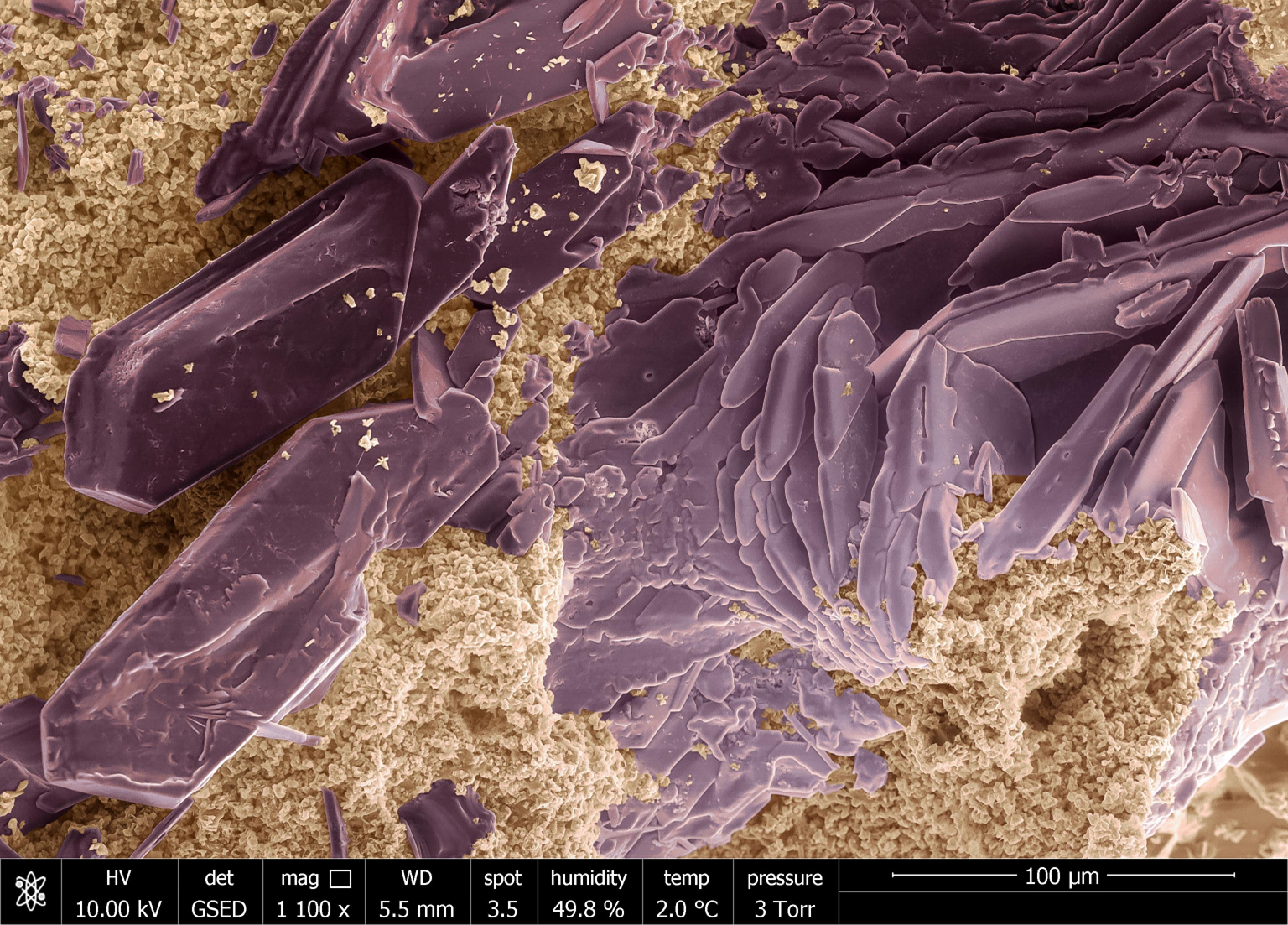
Colored image of in-situ Na2SO4 precipitation on a lime-cement mortar substrate, obtained using Environmental Scanning Electron Microscopy (ESEM) at the Center for Scientific Instrumentation (CIC), University of Granada. The image was acquired at 1100x magnification, 50% relative humidity, temperature 2 °C and 3 Torr pressure.
The main objective of this branch of the SUBLime project is the 3D microstructural characterization of the current and new generation lime-based mortars and plasters using high resolution X-ray imaging. These models will be used to validate the products’ performance towards efflorescence and damage caused by single salts using accelerated efflorescence and carbonation tests on the lime-based mortars to compare the variability of the damage caused by the different pore structures. The internal and external physical changes will be monitored using dynamic X-ray imaging and ESEM.
FIGURE: Colored image of in-situ Na2SO4 precipitation on a lime-cement mortar substrate, obtained using Environmental Scanning Electron Microscopy (ESEM) at the Center for Scientific Instrumentation (CIC), University of Granada. The image was acquired at 1100x magnification, 50% relative humidity, temperature 2 °C and 3 Torr pressure.
FluidControl: modifying the pore network and fluid flow to improve the durability of sedimentary rocks against salt damage
Keywords: building materials, fluid flow, crystallization, chemical reactions
Funding: FWO
PI: Veerle Cnudde
Rock disintegration due to salt decay has significant environmental and economic consequences. It can damage cultural heritage sites and infrastructure; it can impact the hydraulic properties of sedimentary rocks, which affects groundwater resources and soil stability; and salt crystallization can alter the pore, leading to changes in their permeability and hydraulic conductivity which can have far-reaching effects on the water cycle, ecosystem functioning, and the stability of geological formations. FluidControl will impact salt decay by modifying pore dynamics and thereby changing fluid flow and salt crystallization.
FIGURE: Micro-CT imaging of sodium sulfate crystallization in Savonnieres limestone.
Development of a Multi-Axis Loading Platform for In-Situ 4D Imaging of Material Interactions
Keywords: mechanics, micro-CT methods
Funding: BOF-UGent
PIs: Veerle Cnudde, Mahya Roustaei Hossein Abadi, Joris Van Acker, Patrick De Baets, Roman Wan-Wendner, Bruno Stuyts
Multi-scale characterization of the core structure of lightweight gypsum materials
Keywords: building materials, micro-CT methods, mechanics
Funding: industrial funding
PIs: Veerle Cnudde, Veerle Boel
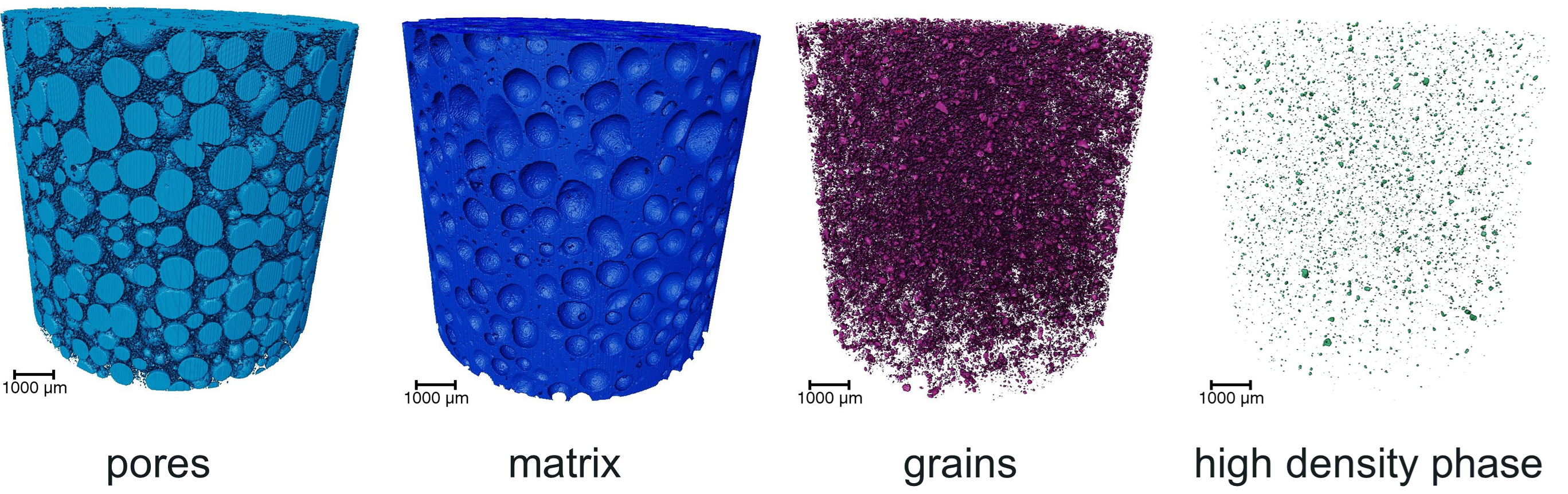
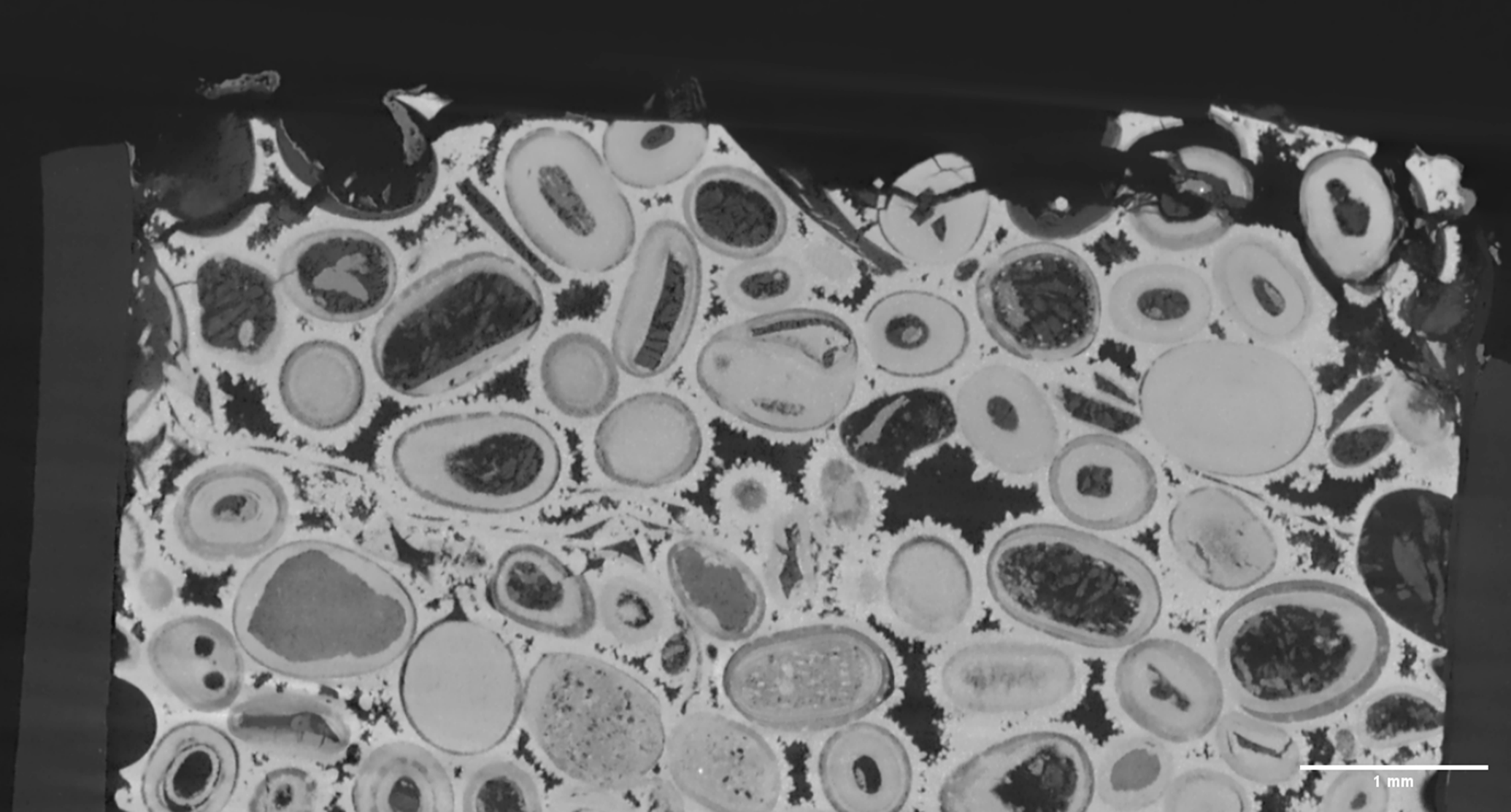
Like many sectors across the European Union, the gypsum industry is actively seeking strategies to reduce its environmental footprint by lowering product density while maintaining quality and performance standards. To address this, a resource-efficient strategy that re-duces gypsum and water consumption and thereby lowers energy use without sacrificing mechanical performance is pursued. In this study we establish the relationship between the three-dimensional characteristics of air voids such as volume fraction, size distribution, sphericity, polydispersity, packing density, and tortuosity within the gypsum matrix and the resulting mechanical performance of the material.
FIGURE: Three-dimensional characteristics of the gypsum core structure.